


Frontline workers keep operations running, but productivity challenges like low engagement, unclear communication, and lack of recognition can quickly impact performance.

Back to Blog
Executive Summary
Frontline workers power the industries that keep economies moving, yet frontline worker productivity remains one of the most persistent challenges organizations face. Low engagement, unclear workflows, limited recognition, and high turnover rates quietly erode performance and business results every day. This article breaks down what drives these problems and how organizations can build frontline teams that perform consistently.
Frontline worker productivity is the measure of how efficiently, accurately, and consistently customer-facing and operational employees complete their core tasks while sustaining performance over time.
It is observable in real-time through key operational metrics, including:
Productivity is not defined by speed alone. High-performing frontline teams balance execution speed with quality, reliability, and long-term workforce sustainability to avoid fatigue and burnout.
Roles such as warehouse operators, retail associates, delivery drivers, healthcare staff, manufacturing workers, and field technicians represent an estimated 75–80% of the global workforce. Their productivity has a direct impact on customer satisfaction, operational efficiency, safety, and overall business performance.
When frontline teams perform well, the whole organization benefits, from higher customer satisfaction to stronger operational efficiency. When they don’t, the costs compound quietly. According to Gallup, disengagement cost the global economy an estimated $10 trillion in lost productivity in 2025, equivalent to 9% of global GDP.
Disengaged employees make more mistakes, deliver inconsistent service, and leave sooner. Engaged employees are more productive than disengaged ones and significantly less likely to quit.
There’s also a direct line to customer experience customer experience and customer service quality. Frontline workers are the face of the brand. Their motivation, or lack of it, shapes every customer interaction. Organizations that invest in frontline productivity don’t just improve operations; they build a long-term competitive advantage that’s hard to replicate.
The connection between employee experience and output is well established. When frontline workers feel valued, supported, and clear on their goals, they perform better and stay longer. Yet many remain disconnected from the organizations they represent.
According to Quinyx’s Frontline Workforce report, 66% of frontline workers have experienced work-related stress, up 5% from the previous year. McKinsey research adds that workers who believe they have the skills to do their jobs effectively tend to both stay and perform better.
Invest in the experience, and productivity follows. The elements that matter most:
When these are in place, the impact on workforce productivity is measurable, not marginal.
Productivity problems on the frontline are rarely about individual effort. They’re systemic. These are the four most common culprits.
When employees don’t know what success looks like that day, they can’t perform consistently. Unclear priorities create wasted effort, inconsistent execution, and frustration, often without anyone realizing it until the numbers slip.
Frontline work is fast-paced and repetitive. Without consistent recognition, motivation fades. A significant share of frontline workers report feeling less valued than their office-based counterparts, and that perception directly affects engagement and performance.
Updates that arrive late, inconsistently, or through informal channels force frontline teams to guess what matters. This disconnect erodes trust and makes operational consistency across locations nearly impossible to sustain.
Without clear metrics and real-time feedback loops, employees can’t self-correct, managers can’t coach effectively, and leaders can’t identify where to intervene. Performance problems grow silently until they become costly. Turnover rates approaching 50% in some frontline sectors are often the most visible symptom.
Addressing root causes requires more than one-off initiatives. These five strategies consistently deliver results.
Employees perform better when they know exactly what success looks like. Define specific daily targets at the individual and team level, connect them to KPIs that matter for the business, and communicate priorities consistently across all shifts and locations.
Weekly reviews are too slow for the frontline. Real-time feedback through dashboards, shift summaries, or live performance tools lets employees course-correct quickly, celebrate wins as they happen, and stay motivated throughout the day.
Recognition is one of the most powerful and underused productivity levers on the frontline. Integrate it into daily workflows rather than reserving it for quarterly reviews. Celebrate both individual and team achievements, and make it visible — public acknowledgment has a stronger motivational effect than private praise.
Every frontline team should receive the same priorities, at the same time, through the same channel. Adopt a single reliable communication platform, standardize how updates are shared, and create two-way loops so frontline employees can give feedback upward.
Gamification applies game-like mechanics — challenges, leaderboards, rewards — to workplace performance. When employees can see their progress in real time and compete in healthy, collaborative ways, motivation increases organically.
Platforms like vaibe integrate directly with existing WMS and operational tools, turning the KPIs already being tracked into engaging performance journeys that increase employee engagement and sustained productivity, without disrupting existing workflows.
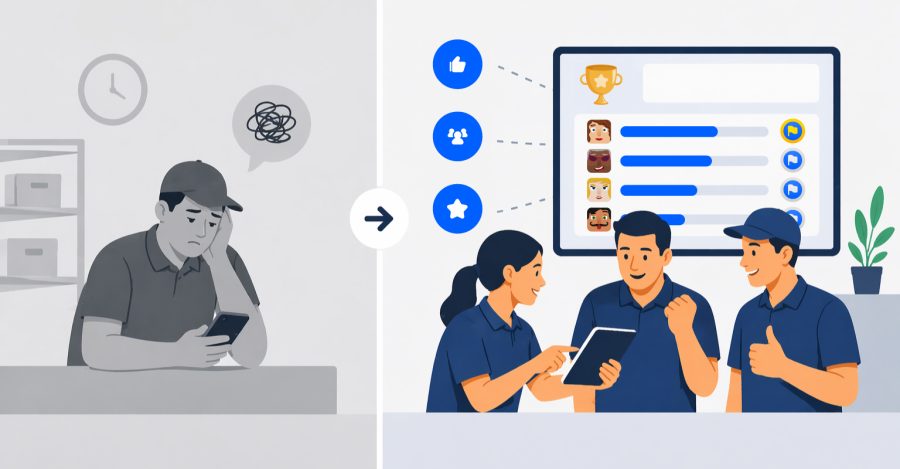
CITY Furniture’s warehouse teams were working hard, but leadership had limited visibility into individual performance, and recognition was inconsistent. High turnover and low engagement were dragging results.
After integrating vaibe’s gamification solution with their existing WMS — live within two weeks — the shift was immediate. Managers moved from monitoring to coaching. Individual competition gave way to team-based challenges. Daily work became something people felt connected to.
Results:
The technology made the performance visible. The recognition made it meaningful. Together, they made it stick.
Frequently Asked Questions
What is frontline worker productivity?
Frontline worker productivity is how efficiently and effectively employees in direct-delivery, customer-facing, or operational roles perform their tasks, measured in real time through metrics like pick rates, order accuracy, and service response times.
Why do frontline workers often have lower productivity than office‑based employees?
Frontline workers typically operate with less leadership visibility, fewer digital tools, more physical demands, and limited access to recognition or development. These structural gaps drive the productivity difference.
Why does a great frontline worker experience boost productivity?
A great frontline worker experience improves engagement, reduces turnover, and gives employees clearer goals and real-time feedback. When frontline workers feel supported and empowered, productivity, service quality, and customer satisfaction all improve.
How does employee engagement affect frontline productivity?
Engaged frontline employees are more productive and significantly less likely to leave. Engagement has a direct, measurable impact on operational efficiency, customer satisfaction, and turnover costs.
What are the most effective ways to empower frontline workers?
Real-time visibility into goals and progress, consistent recognition built into daily workflows, standardized communication across locations, and tools that make performance motivating, such as gamification platforms, are the highest-impact levers.
How quickly can companies see results from frontline productivity initiatives?
Organizations that combine clear goal-setting, recognition systems, and integrated performance tools often see measurable results within weeks. CITY Furniture saw an 11% productivity increase within weeks of going live with vaibe.
Share:


Boosting warehouse productivity is essential for faster fulfillment, lower costs, and better overall performance. By optimizing processes, leveraging technology, and keeping teams engaged, organizations can eliminate inefficiencies and create smoother, more consistent operations.
Discover how gamification transforms warehouse operations and business results with vaibe’s seamless WMS integration.
Discover how blending competition and collaboration in the workplace can drive employee engagement, all through the unique lens of a Game Designer. Explore strategies that turn everyday tasks into meaningful, motivating experiences.
Explore the transformative power of gamification. Actionable strategies and real-world examples to improve your workplace.