


Warehouse performance metrics are essential to manage teams that work in the field. But which are the most importante metrics – and how can teams measure them?

Back to
In a supply chain environment, warehouse teams play a vital role in ensuring goods flow smoothly and customers stay satisfied. But maintaining efficient operations is only part of the job. To truly succeed, warehouse managers need clear visibility into what’s happening on the floor, the ability to monitor performance in real time, and the tools to inspire teams to drive continuous improvement. That’s where warehouse performance metrics become essential.
In the words of a wise Peter Drucker:

Metrics like order accuracy, pick rates, inventory turnover, and on-time shipments reveal much more than numbers in a report. They offer a real-world view of efficiency, highlight bottlenecks, and uncover opportunities to improve employee engagement, productivity, and accuracy rates. Without a firm handle on these KPIs, even well-run operations risk slowdowns, costly mistakes, and decreased morale.
In this article, we will break down the 5 most important warehouse performance metrics, explain why they matter, and show how managers can better track these KPIs and use tools to boost performance, employee engagement, and profitability.
Inventory accuracy is essential for maintaining reliable stock levels, minimizing losses, and overall ensuring customer satisfaction. But let’s explore this in more detail in a bit. Just remember, for a warehouse to run like clockwork, inventory data needs to be accurate.
The right inventory balance
Accurate inventory tracking helps ensure warehouses have the right amount of stock. This is important because stockouts lead to missed sales, frustrated customers, and lost revenue, while overstocking eats up any budget and valuable warehouse space. Maintaining this balance is essential to keep stocks moving and clients happy.
Enable better business decisions
Having firm grasp on inventory also helps to enable better business decision-making. When inventory data is correct, all of purchasing plans, restocking strategies and sales forecasts are grounded in facts. You know precisely what sells fast, what doesn’t.
Reduced operational costs
Poor inventory accuracy often results in more time spent on manual checks and re-counts. Keeping inventory accurate helps you identify missing stock due to damage, misplacement, or theft. It also supports sustainability by preventing overstocking of slow-moving goods, which lowers storage costs, reduces unnecessary spending, and minimizes waste in the long run.
How to calculate: Inventory accuracy = (1 – (variance / recorded inventory)) x 100
If a documented stock count is 1000 units and the actual count is 950, the variance is 20 units. This means accuracy is 96%. Generally, a rate of 95% or above is commendable.
Order accuracy is a straightforward way to measure how often a business delivers exactly what a customer ordered. It assesses whether the correct products arrive with the right specifications, packaging, and at the correct place and time. If any part of the order is wrong, the order is considered inaccurate. Clear delivery documentation helps verify that orders were delivered correctly and on time, giving customers confidence and providing businesses with better insight into their fulfillment process performance.
When order accuracy is high, customers receive what they expect when they expect it. This leads to positive experiences, builds trust, and encourages repeat business. It also helps companies save money by reducing returns, preventing waste, controlling inventory, and staying competitive. In the long run, consistently accurate orders support healthier growth and stronger customer relationships.
How to calculate: order accuracy rate = (total perfect orders ÷ total orders) x 100
A good order accuracy rate is typically around 96% to 98%, considered the benchmark for high-performing businesses, but the goal is to get as close as possible to 100% .
Order cycle time is the period a company takes to complete the entire order fulfillment process, from when the customer places an order to when the product is delivered. This cycle includes several steps such as order processing, picking, packing, shipping, and delivery. It can vary depending on factors like the complexity of the product, delivery location, or the company’s size.
In today’s fast-paced environment, it is crucial that companies track their order cycle time and work to reduce it as much as possible, as it is a significant competitive advantage in meeting increasing consumer demands and building loyalty.
How to calculate: Order cycle time = (delivery date – order date) / total orders shipped
The perfect order rate shows how often an order is delivered exactly as intended: the correct product in the right quantity and condition, delivered to the right customer, at the right location and time, with proper packaging, paperwork, and invoice. If even one of these elements is incorrect, the order isn’t considered perfect.
Simply put, this metric assesses how well a supply chain meets customer expectations. While achieving perfection can be difficult, companies with high perfect order rates typically hold less inventory, experience fewer stockouts, and receive payments more quickly. When orders are not perfect, costs increase due to additional handling, replacements, and lost sales. Improving perfect order performance helps reduce inefficiencies, lower costs, and enhance customer satisfaction. Greater visibility across systems makes it easier to spot issues, address them, and continually improve performance.
How to calculate: Perfect order rate = (Count of perfect orders / total number of orders) X 100
Although the benchmark varies depending on the industry, operation, and even customer expectations, a result of 90% or above is deemed excellent in most cases.
Warehouse capacity utilization measures how much of an available storage space is actually in use. Hitting 100% utilization isn’t the goal, warehouses need free space for moving goods, operating equipment, and allowing workers to pick and pack safely.
Typical utilization rates range from 40% to 85%, depending on factors such as inventory turnover, product types, storage systems, and handling equipment. Tracking this metric helps companies use space more effectively, reduce costs, improve fulfillment speed, and increase overall efficiency. This is especially important as warehouse construction costs have risen by nearly 50% since 2021. With better space management, companies can increase capacity within their existing facilities, avoid costly expansions, speed up picking and packing, and create smoother, more efficient workflows.
How to calculate : warehouse space utilization = (used space / total available) x 100
Ensuring these KPIs are tracked and considered to form data-driven decisions is a step in the right direction, but is it enough?
Modern warehouse management systems (WMS) generate an enormous amount of data, but data alone doesn’t drive improvement. Many warehouse teams struggle to translate KPIs into meaningful actions employees can understand, follow, and stay motivated by. That’s where vaibe comes in.
By layering gamification elements, like points, badges, challenges, and leaderboards on top of WMS insights, vaibe turns everyday warehouse tasks into motivating milestones. These game mechanics help teams stay focused on what matters most, build healthy competition, and align daily behaviors with operational goals.
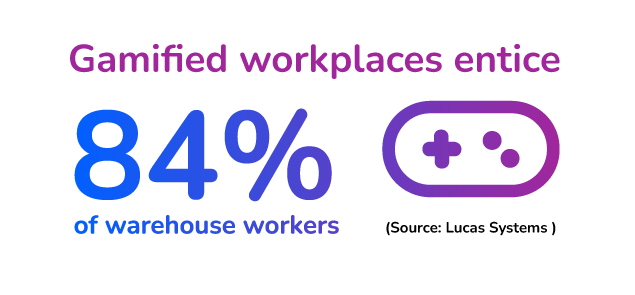
And the impact is more than theoretical. A 2024 study by Lucas Systems found that nearly 84% of warehouse workers are more likely to stay with a company that introduces friendly, task-based competitions. Gamified challenges, teamwork-based missions, and recognition rewards make work more enjoyable and performance noticeably stronger.
Tracking KPIs is essential, but KPIs alone don’t change behavior. vaibe bridges the gap between measurement and motivation, helping warehouse managers turn insights into real-time action.
Performance
By monitoring individual and team progress across tasks like picking, putaway, and order accuracy, vaibe provides instant feedback and rewards. Employees stay engaged, motivated, and eager to improve key productivity metrics.
Safety
Gamified safety modules, training challenges, badges, streaks, and progress levels encourage teams to complete mandatory refreshers, reduce risky behaviors, and maintain safer warehouse environments.
Customer satisfaction
Rewarding high picking accuracy, shorter cycle times, and lower avoidable return rates reinforces the behaviors that directly impact customer experience. The result: faster orders, fewer mistakes, and happier customers.
In short, vaibe turns warehouse KPIs into clear goals, positive motivation, and continuous improvement, bringing warehouse performance to life every single day.
If you are ready to unlock warehouse performance for your clients, book a demo today!
Share:


Discover what is an OKR and how this framework, together with gamification, can impact results within a teams and companies.
Find out how vaibe engagement layer boosts operational efficiency in warehouses with gamification.
Discover how gamification transforms warehouse operations and business results with vaibe’s seamless WMS integration.
Learn how a gamified solution can engage employees, reduce turnover, and enhance last mile delivery productivity.