


With markets fragmenting and consumers demanding more value, retail’s next battleground is operational consistency.

Back to Blog
Executive Summary
Retail growth is becoming uneven, with consumers simultaneously trading up and down, creating fragmented demand and tighter margins.
In this environment, price alone is no longer enough. A large share of perceived value comes from execution: product availability, service, and fulfillment reliability.
As expansion gives way to discipline, retailers are focusing on controllable levers like supply chain resilience, inventory, and labor productivity.
The real competitive edge now lies in operational consistency: how reliably strategy is executed in stores, every day. Retailers that can monitor and adjust execution in real time will outperform in an increasingly volatile market.
Have you noticed how people shop today? Someone picks up a premium face cream and then walks over to the discount rack for basics. Retail no longer moves in a straight line. It’s shifting in uneven ways.
More shoppers are doing the small math in their heads. Do I really need this? Is there a cheaper version?
That shift is squeezing retailers from both sides. Customers are watching every dollar, while margins leave very little room to move. Supply chains are being reconfigured in response to price volatility and economic pressure.¹ None of these trends are playing out alone. They are creating patchy demand conditions across markets, categories, and customer groups.
However, the squeezed consumer wallet, economic uncertainty, and trade tensions have not dampened growth forecasts.¹ Opportunity and constraint coexist, often within the same portfolio. That tension defines the current retail environment more accurately than any headline about recession or recovery.
Value-seeking behavior has changed from a reactive approach to a regular habit. It is not just a temporary reaction to inflation. Consumers are comparing prices and delaying their purchases more often until the big sale season arrives. They are switching brands for lower prices in some categories while staying loyal in others. Retailers have reacted by organizing pricing and product selection more carefully. They are using tiered private labels, targeted promotions, and assortments that fit specific micro-markets.¹
Yet this segmentation reflects something deeper. Different consumer groups are prioritising spending in different ways simultaneously.
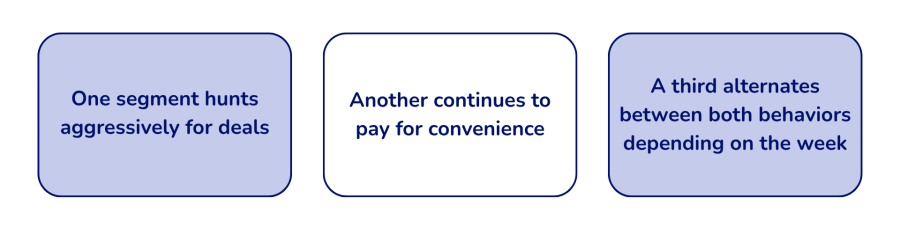
Retailers are now meeting a broader range of demand sensitivities simultaneously. This complexity does not fit into one pricing strategy. It impacts merchandising, staffing, inventory distribution, and store operations. The shift in consumer behavior has increased the gap between what the strategy aims for and what daily operations need to provide.
Price still matters. It always will. But it does not explain the full picture of why one retailer wins, and another loses.
Roughly 40% of perceived value is shaped by non-price factors.¹
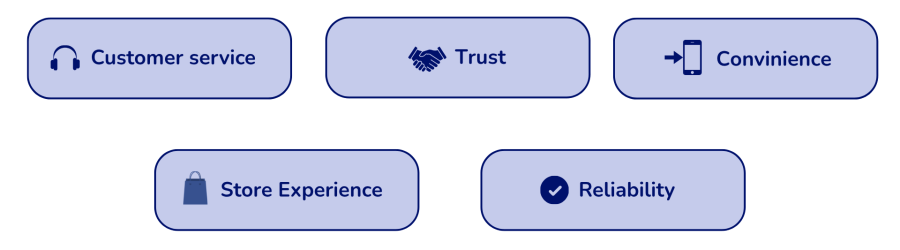
These elements are harder to measure, which is why they are often neglected.
By understanding these factors and developing a matching value proposition, businesses can stand out even in price-sensitive markets. More value comes from the consistency with which the experience is provided. The strategy may set the promise, but execution determines if that promise is kept.
There was a long stretch when scale functioned as a strategy. More stores signaled momentum. Wider assortments implied relevance. Geographic expansion was as proof of strength. Capital flowed accordingly.
The environment now rewards a more restrained approach. Boards are asking tougher questions about return on invested capital, inventory productivity, and the real cost of complexity.
The way we think about the supply chain is changing. Years ago, people did not take this as seriously as they do now. The reason for this change is that material costs have risen, and geopolitical factors affect how countries work together. This has exposed the vulnerability of highly optimized global chains.
Businesses are now seeking ways to make the supply chain safer. Dual sourcing, strategic nearshoring, and reduced inventory buffers are not about transformation. They are about mitigating risk to avoid the potential for steady erosion of margin. AI-based forecasting and replenishment tools are part of this movement, particularly when they enhance demand-forecasting accuracy and improve working-capital productivity.
Collectively, these trends signal a shift. Growth remains a priority, but there is a renewed emphasis on the levers and pillars that retailers can control. These include cost management, inventory turns, labor productivity, shrinkage management, and in-store execution.
The competitive attention is shifting from expansion visibility to knowing exactly where execution is breaking down and fixing it before it hits the P&L. This is not typically front-page news. Rather, it manifests as more consistent margins, fewer surprises, and companies that spend less time fixing preventable errors.
Economic fragmentation, persistent value-seeking, and tighter margins all increase the variability of day-to-day retail operations. Forecasts change faster. Promotions need closer coordination. Labor deployment becomes more sensitive to changes in local demand.
Deloitte has noted that future competitiveness in retail will depend on operational excellence, adaptability, and data-driven insights. This observation is significant because it reflects what many operators already sense. Strategy cycles are getting shorter. The gap between planning and execution is decreasing.
What this means is that retailers need to respond more quickly in terms of store and front-line execution. A shift in demand cannot wait for a quarterly review. A supply disruption cannot sit in a report. Changes in daily operations need to be made almost in real time. This is why consistent execution is moving from a back-office concern to something that shows up directly in revenue and margin.
Retail executives are beginning to focus more on how new business priorities are reflected in execution.
Better visibility into daily execution helps retailers:
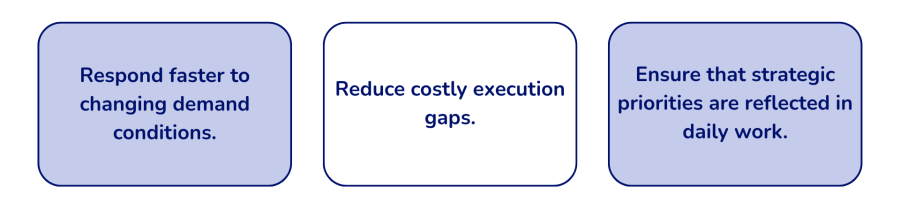
The key question is no longer just “What is our strategy?” It is “How reliably does that strategy show up in stores every day?”
At vaibe, we are noticing a distinct shift in where retail leaders are focusing their attention. The discussion is moving toward the execution layer, where commercial priorities either become daily actions or lose their impact. The interest is shifting from dashboards for their own sake to the need for clarity.
Most retail strategies are not inherently flawed. They just get weaker when they are translated. A marketing strategy may not be executed properly across all locations. A labor strategy may be very efficient, but may not have enough staff during peak times. A change in category emphasis may not be clearly understood by store staff, who are juggling multiple tasks at once. It is these inconsistencies that will eventually affect customer experience and profit, not the strategy itself.
Operational intelligence at this level is about making these translations visible. It gives leadership a clearer view of how daily actions align with changing business priorities and where adjustments are needed before performance problems become widespread.
Reference
1. Deloitte, 2026 Retail Industry Global Outlook, 2026
1. What is driving change in the retail industry today?
Retail is being reshaped by changing consumer behavior, inflation, and supply chain volatility, leading to uneven demand and tighter margins.
2. Why is operational consistency important in retail?
Operational consistency ensures that pricing, promotions, and customer experience are executed reliably across all stores, directly impacting revenue and margins.
3. How has consumer behavior in retail changed?
Consumers are more price-sensitive, comparing options, delaying purchases, and switching between premium and budget products depending on the category.
4. How can retailers improve operational efficiency?
Retailers can improve efficiency through better inventory management, labor optimization, supply chain resilience, and data-driven decision-making.
Share:


Understand how gamification boosts employee engagement by setting clear goals, rewarding accomplishments, and enhancing teamwork.
Discover how gamified performance review tools boost engagement, growth, and real-time feedback.
Struggling with disengaged teams, inefficiencies or high turnover?
Discover how gamification transforms challenges into wins!
Isabelle Krause, Head of HR & Culture at Körber Digital, wrote this article to explore the impact of gamification in the field. She highlights where gamification adds value and where its limitations call for a well-defined strategy.