


Discover why retail turnover is rising and how gamification boosts motivation, reduces churn, and helps frontline teams stay engaged and productive.

Back to
In the retail industry, nothing matters more than the people who greet customers, restock shelves, and keep the business running smoothly.
At the frontline, the employees, cashiers, floor associates, stockers, and service reps give life to a brand. Their attitude, motivation, and performance don’t just influence customer satisfaction; they directly shape sales, loyalty, and the overall customer experience.
But there’s a problem everyone knows all too well: employee turnover in the retail industry is skyrocketing.
Retail has one of the highest turnover rates of any industry worldwide. According to McKinsey, on average, turnover in the retail industry is around 60%, meaning that more than half of the workforce may be gone within a year.
Employees often cycle in and out within months, creating a constant loop of hiring, onboarding, and training. Many workers leave because they don’t feel recognized, supported, engaged or connected to the larger purpose. Others burn out due to repetitive tasks and/or inconsistent feedback.
The reality is simple: when people don’t feel valued or recognized, they leave.
Turnover isn’t just an HR inconvenience. It also comes with a hefty price tag.
Built In says, replacing a single retail employee can cost anywhere from 1.5 to 2 times their annual salary when you factor in:
Multiply this by dozens or hundreds of employees, and the financial hit becomes impossible to ignore. High turnover also leads to inconsistent customer experiences, which can quietly erode brand loyalty and, ultimately, sales.
Reducing turnover isn’t only about pay raises, flexible shifts, or increasing benefits (even though those help). The deeper challenge is motivation.
Retail employees often operate in challenging, fast-paced environments where recognition is rare and progress is invisible. Without meaningful feedback or clear growth opportunities, engagement drops sharply.
Gallup estimates that disengaged workers cost the global economy $9.6 trillion in lost productivity.
The solution? Make work feel more rewarding, every single day – and that’s where gamification enters the scene.
Gamification taps into basic human drivers: achievement, competition, recognition, and progress. Instead of relying on quarterly reviews, vague words of encouragement, or the usual “pat on the back,” it provides real-time engagement through:
Let’s look at some practical examples!
Gamification is an effective way to keep retail employees motivated and boost in-store efficiency. Research by the career expert Zippia found that 90% of employees reported that gamification made them more productive at work.
By using gamification, companies can develop internal scoring systems or rankings based on employee performance. Challenges, such as weekly sales goals, the number of customers assisted, or quality of service, can be included. After the purchase, the customer is invited to complete a short survey evaluating the experience and the employee.
The latter immediately receives feedback and a performance score, helping him adjust or validate his approach. This gamification strategy motivates employees to compete on leaderboards and earn rewards, badges or special recognition for achieving specific objectives.
It’s no secret that different departments should work together like a well-oiled machine. But is that always the case? Not necessarily, unless gamification can help.
For example, by establishing common goals, such as efficient stock replenishment, which requires strong communication and collaboration between the sales and inventory departments, employees can work together to achieve positive results for the company as a whole and earn rewards.
With this approach, retail companies can say “bye-bye” to silos and promote a unified work environment that encourages peer recognition, effective sharing of resources and knowledge, and most importantly, boost productivity.
One factor that disengages employees is the feeling that the company doesn’t value them. A lack of investment in both professional and personal growth causes employees to lose focus and look for other opportunities.
According to Talentlms, 83% of those who receive gamified training feel more motivated.
By introducing game-like elements into training, employees can earn certifications by completing a set number of goals or mastering a new skill, which not only shows employees that the company is invested in their development but also makes the process more enjoyable and motivating. With this, employee engagement is set to skyrocket.
Another benefit is that these employees become better professionals, more efficient, increasing the value they add to your company and the services they provide.
Although only scratching the surface of gamification’s potential, implementing such strategies transforms routine tasks into engaging experiences. They make performance visible and energizing. Most importantly, they give employees a sense of purpose, accomplishment and comradery, three things strongly linked to employee retention.
These elements turn routine tasks into engaging experiences. They make performance visible and energizing. Most importantly, they give employees a sense of purpose and accomplishment, two things strongly linked to employee retention.
vaibe brings all these mechanics together in a single, intuitive platform designed specifically to motivate, energize, and retain frontline teams.
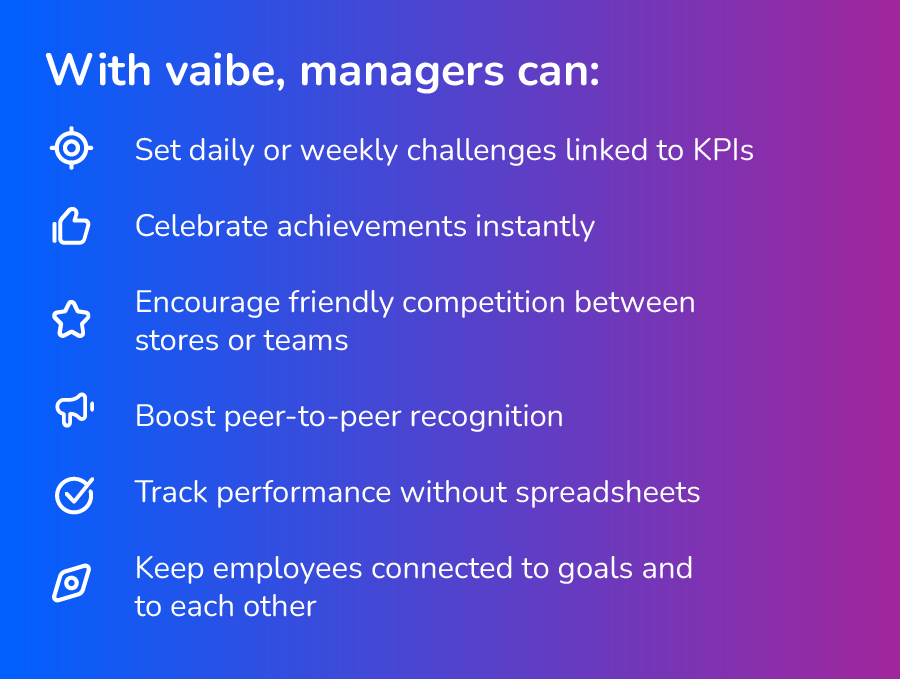
High turnover doesn’t have to be “just part of the game.” For retail employees, vaibe makes progress feel visible and rewarding. For managers, it becomes a powerful tool to build stronger, happier teams that want to grow and deliver the best service to their customers.
Request a demo and discover why vaibe isn’t just a gamification solution. It’s a new way to keep retail teams engaged, productive, and choosing to stay.
Share:


Find actionable gamification strategies to enhance sales, reward retail teams, and build lasting customer loyalty.
Employee engagement in retail is crucial. Discover how gamification boosts motivation and why vaibe is taking this message to K5 Future Retail Conference 2025
Understand the real cost of employee turnover and how gamification can help reduce it.
Explore the transformative power of gamification. Actionable strategies and real-world examples to improve your workplace.