


Sales teams may strive to achieve numbers and sales, but their motivation often goes beyond that. So, what should managers to keep their sales teams motivated?

Back to Blog
Sales teams are the driving force behind every company’s growth. They’re out there every day building relationships, closing deals, and fueling revenue. But if you’ve ever led a sales team, you know that keeping motivation high comes down to one important thing: people.
Financial incentives help, of course. Commissions and bonuses drive short-term performance, but they’re not always enough to sustain engagement in the long run. Studies show that sales teams value personal growth, transparency, and having a sense of purpose above status or monetary compensations. Without those motivators, even top performers can lose momentum or burn out.
So how do you motivate your sales team to stay engaged, inspired, and consistent over time? Let’s break it down into actionable strategies.
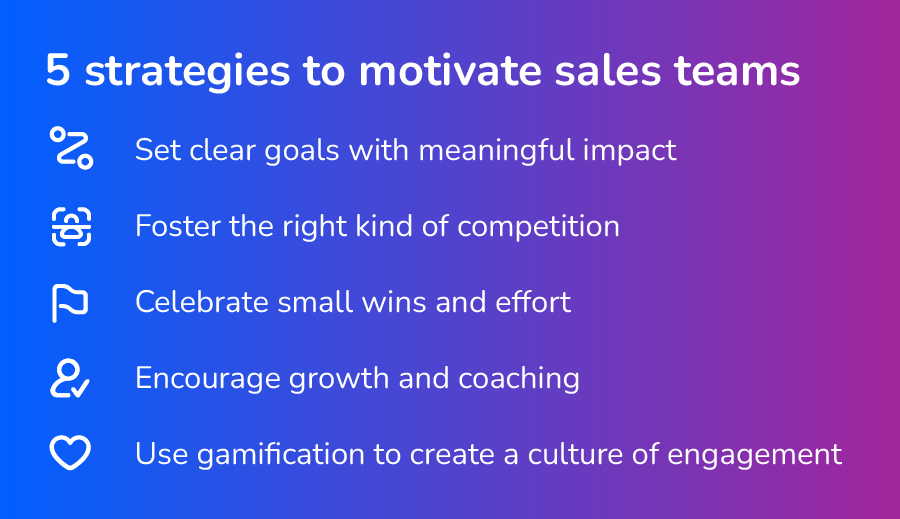
Motivation starts with clarity. When sales reps understand exactly what they’re working toward, and why it matters, they’re more likely to stay focused and driven.
Sales managers should set clear, achievable, and inspiring sales goals that align with both company objectives and individual aspirations. Instead of vague targets like “increase sales,” aim for goals that connect to real impact:
Clear objectives build a sense of purpose. Reps can see how their efforts directly influence company growth, customer satisfaction, and their own professional success.
Salespeople are naturally competitive: it’s part of what makes them great. But unmanaged competition can create tension or burnout. The key is to channel that energy into healthy competition that strengthens collaboration instead of undermining it.
This is where gamification and game mechanics come in. Tools like leaderboards, progress tracking, and performance badges make competition visible and exciting without creating unnecessary pressure.
Imagine your team earning points for hitting milestones, leveling up as they close deals, or unlocking rewards for helping teammates. Suddenly, sales performance feels more like a shared game than a grind.
The result? Motivation stays high, engagement levels rise, and your sales culture becomes more dynamic and supportive.
Recognition is one of the most powerful motivators for any team. Salespeople want to see their effort seen.
Celebrating small wins helps maintain momentum during slower periods. Whether it’s closing a tough deal, booking a record number of demos, or improving call-to-close ratios, every achievement deserves acknowledgment.
Peer-to-peer recognition is especially effective. When team members celebrate each other’s wins, publicly or in shared channels, it builds connection and boosts morale across the team.
With tools like vaibe’s real-time kudos, recognition becomes part of daily life. A quick shout-out or badge of appreciation can do more for long-term motivation than a quarterly award ceremony.
To truly motivate your team, think beyond sales numbers. The most successful sales leaders see every rep as someone growing toward their next level.
According to recent data, sales reps who receive ongoing coaching are 58% more motivated. Also, coaching is linked to higher retention rates and and a decrease in turnover.
Ongoing coaching and feedback create a learning experience that strengthens both performance and engagement. When reps receive actionable insights, they feel supported and invested in.
Gamified coaching can make this process even more engaging. Imagine a system where sales reps earn points or badges for completing training modules, improving soft skills, or mastering new tools. This approach turns professional development into an active, rewarding experience rather than a chore.
The most motivated sales teams thrive in a culture where progress feels rewarding and effort is recognized along the way. That’s exactly what gamification brings to sales motivation.
By introducing game mechanics such as points, badges, levels, and leaderboards, sales leaders can turn everyday goals into engaging challenges. Instead of viewing performance metrics as pressure, reps start to see them as opportunities to level up, earn recognition, and celebrate collective success.
For example:
These small, consistent moments of recognition build lasting motivation, making the sales journey more interactive and fun.
vaibe brings gamification to life with built-in tools like real-time kudos, adaptive leaderboards, and feedback loops that fit naturally into teams’ daily workflow. Managers can easily customize how progress is tracked, ensuring that recognition feels personal and aligned with each team’s sales goals.
When gamification becomes part of a company’s culture, recognition happens continuously, not just at the end of the quarter. The result is a more energized, connected, and high-performing sales team that enjoys the process of reaching its targets as much as the results themselves.
Learning how to motivate a sales team doesn’t take reinventing the wheel. In the end, it’s all about understanding what truly drives people. Clear goals give direction, gamification makes progress fun, and recognition fuels intrinsic motivation.
With the right mix of structure and engagement – and the help of tools like vaibe – sales leaders can transform performance management into something that feels meaningful, dynamic, and human.
When motivation becomes part of the culture, sales results follow naturally.
Share:


Discover how gamification simplifies measuring team performance with real-time feedback and clear metrics.
Discover what is an OKR and how this framework, together with gamification, can impact results within a teams and companies.
Discover how gamification can support professional growth by turning goals into engaging, trackable progress.
Learn effective strategies to boost employee engagement, retention, and workplace satisfaction.