


Retail employees are the backbone of a business. But how can companies reduce turnover and keep their teams engaged and and frontline ready? Gamification might be the answer.

Back to Blog
Retail employees thrive when they feel recognized, empowered, and connected to clear goals.
On the sales floor, motivation directly impacts customer experience, consistency, and revenue. According to research, companies with highly engaged employees can outperform their peers by 147% in earnings per share, showing the impact of a motivated workforce.
However, around 59% of retail workers have considered quitting their jobs. Even though employee motivation greatly impacts business outcomes, companies are still missing the big picture.
Many retail teams still rely on traditional management approaches, like static targets and top-down communication, struggling to create a real sense of ownership or enthusiasm.
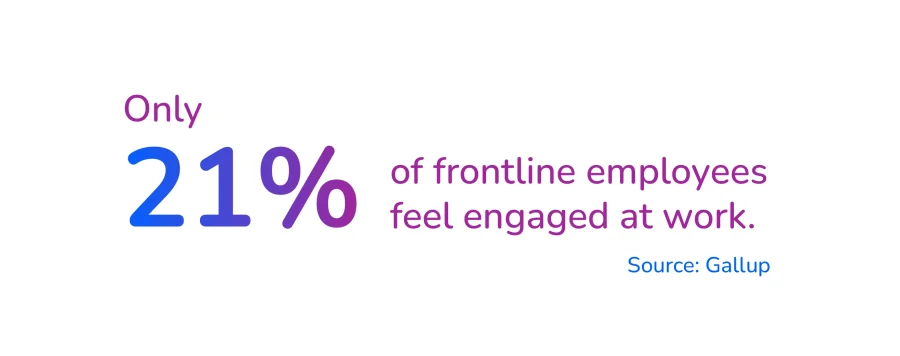
The result is familiar across the industry: disengaged employees, uneven performance, and high turnover. According to Gallup, only 21% of frontline employees feel engaged at work, a figure that reflects how difficult it can be for retail teams to stay motivated in fast-paced, repetitive environments.
To elevate retail management, leaders need to rethink how goals are communicated, how progress is tracked, and how effort is recognized. And not just during review periods, but every single day.
Retail work is demanding by nature. Employees balance customer expectations, sales targets, operational tasks, and time pressure, all at the same time. With this, some challenges arise.
Lack of visibility into progress
Many employees know what they’re expected to do, but not how well they’re doing in real time. When progress toward goals is unclear, motivation drops and performance becomes inconsistent.
Recognition that comes too late… or not at all
Research shows that 78% of employees say recognition makes them more motivated at work. However, in retail, praise is often informal, inconsistent, or reserved for top performers only, leaving many efforts unnoticed.
Short-term focus on results
Sales numbers matter, we can agree on that. But focusing exclusively on outcomes can overlook behaviors that drive long-term success, such as proactive customer service, teamwork, and product knowledge.
Difficulty maintaining engagement across shifts and teams
Retail teams are often spread across different schedules and locations, making it hard to keep everyone aligned and connected to shared objectives.
Employees perform better when goals are specific and easy to understand. Whether it’s daily sales targets, customer satisfaction metrics, or product-knowledge goals, clarity creates confidence and accountability.
Waiting for monthly or quarterly reviews isn’t enough in a fast-moving retail environment. Employees need frequent signals that show what’s working and where they can improve.
When people can see their progress, motivation increases. According to Harvard Business Review, employees who can track progress toward goals are significantly more engaged and productive. So, the task is: make progress visible and understandable to everyone.
Recognition doesn’t need to be expensive to be effective. Public acknowledgment, appreciation for effort, and celebration of milestones all reinforce positive behaviors and strengthen engagement.
The challenge for retail managers is finding a scalable, engaging way to deliver all of this consistently.
This is where many retail leaders begin looking beyond traditional management tools and toward more dynamic engagement frameworks.
Some organizations introduce structured systems that make goals visible, celebrate progress, and encourage friendly competition and collaboration, all while keeping teams aligned with store priorities.
How? With gamification, of course.
When applied thoughtfully, gamification introduces elements such as challenges, progress tracking, rewards, and recognition into daily retail operations, turning routine tasks into motivating experiences.
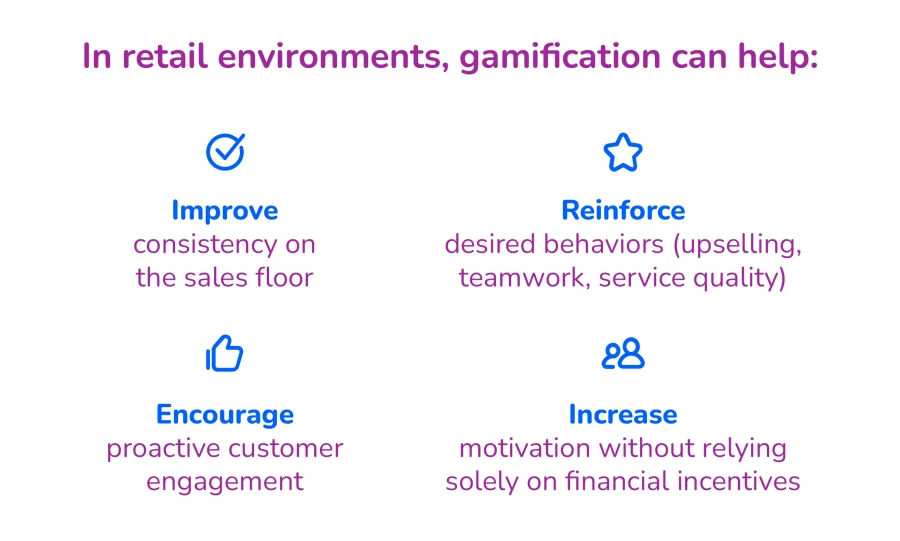
In retail environments, gamification can help:
Effective gamification is all about creating clarity, momentum, and appreciation, elements retail teams often lack.
While the concept of gamification is powerful, execution is where many initiatives fall short. This is where vaibe becomes essential.
vaibe provides retail managers with the tools needed to turn engagement strategies into everyday reality.
Recognition that happens in real time
With kudos, managers and teammates can instantly recognize great customer service, sales wins, or teamwork, reinforcing positive behaviors as they happen.
Real-time challenges aligned with store goals
vaibe allows managers to create challenges tied directly to retail priorities, such as sales targets, customer satisfaction, or product focus campaigns.
Transparent progress tracking
Leaderboards, points, and progress dashboards give employees immediate visibility into how they’re performing, individually and as a team.
Continuous feedback
Retail teams can share input and receive feedback regularly, helping managers adapt strategies and keep engagement high across shifts.
Retail success depends on motivated employees who understand their goals, feel recognized for their efforts, and see how their work contributes to store performance. By addressing common management challenges, retail leaders can build stronger, more committed teams.
Gamification offers a modern way to support this shift, and with vaibe, retail managers have a practical, scalable solution to bring it to life, helping teams stay motivated and focused on delivering great customer experiences. Instead of adding complexity, vaibe simplifies engagement, making motivation, recognition, and alignment part of the daily retail life.
Interested in knowing more? Book your demo today and see vaibe in action with the help of our team!
Share:


Sales teams may strive to achieve numbers and sales, but their motivation often goes beyond that. So, what should managers to keep their sales teams motivated?
See how CITY Furniture used vaibe’s operational performance layer to drive an 11% productivity increase, improve retention rates, and strengthen the relationship between leaders and associates on the warehouse floor.
Implementing gamification solutions in the workplace can be a driver of business results. Let’s explore how.
Understand how to immediately start boosting business productivity with gamification tools that drive real results.