


Gamification goes well with workplace productivity. But how can it be truly implemented to drive success and increase business results?

Back to Blog
Gamification is no longer limited to mobile games, fitness trackers, or customer loyalty programs. Today, it’s becoming a transformative strategy for workplace motivation and performance – and companies already know it.
According to AmplifAI, 70% of Global 2000 companies use some form of gamification, with 78% of employees stating that gamification makes their work more enjoyable and engaging.
Numbers speak for themselves. Gamification is becoming more than a trend, turning into a necessity for teams that want to achieve the best possible outcomes.
When implemented well, gamification helps employees understand what success looks like, feel recognized for their efforts, and stay motivated through visible progress. The result? Higher productivity, better collaboration, and a workplace culture where people feel more connected to their work.
But one question remains: how can companies implement gamification – the right way?
Let’s find out.
At its core, gamification is not about turning work into a game or adding superficial incentives. It’s about using game dynamics to enhance the human experience of work, making daily activities more engaging, meaningful, and motivating.
Effective workplace gamification taps into intrinsic motivators that drive long-term performance, rather than relying solely on external rewards. These motivators are deeply rooted in human psychology and apply across roles, industries, and seniority levels.
Progress: making improvement visible
People are naturally motivated by progress. When employees can see themselves improving, motivation naturally increases.
Gamification makes progress tangible through visual indicators such as progress bars, milestones, or levels. Instead of work feeling endless, employees experience momentum, which encourages sustained effort and persistence over time.
Purpose: connecting tasks to meaningful outcomes
Work becomes more engaging when people understand the “why” to their efforts. Gamification helps connect everyday tasks to broader team or company objectives, giving employees a sense of purpose beyond completing a checklist.
By aligning challenges and goals with meaningful outcomes, such as customer satisfaction, quality improvement, or team success, for example, gamification reinforces the impact of individual contributions.
Recognition: reinforcing positive behaviors
Recognition is one of the strongest drivers of engagement. Feeling seen and appreciated validates effort and reinforces behaviors that support organizational goals.
Gamified systems embed recognition into daily workflows, allowing achievements to be acknowledged consistently and publicly. This not only motivates the individual being recognized but also sets clear examples of what success looks like for the rest of the team.
Belonging: strengthening social connection
Work is inherently social, and gamification encourages belonging by creating shared experiences.
When employees celebrate wins together, collaboration increases and silos break down. This sense of belonging strengthens emotional commitment to the team and the organization, which is especially important in distributed or frontline environments.
Before selecting mechanics like badges or points, companies should identify their goal:
Clear objectives ensure the gamification strategy supports measurable outcomes, not just activity for activity’s sake.
Tip: Prioritize no more than three goals at a time, so the system stays clear and focused.
Gamification offers many mechanics, and each of them influences behavior differently. So, depending on the goal, managers might want to choose one or more mechanics to implement. Let us help you by matching some goals with the most appropriate mechanics to apply.
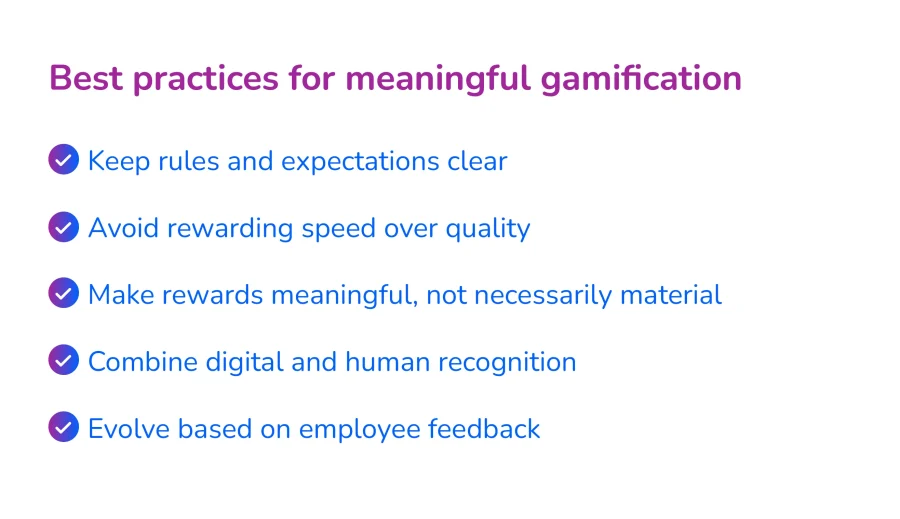
The key is to match mechanics to behaviors you actually want to encourage.
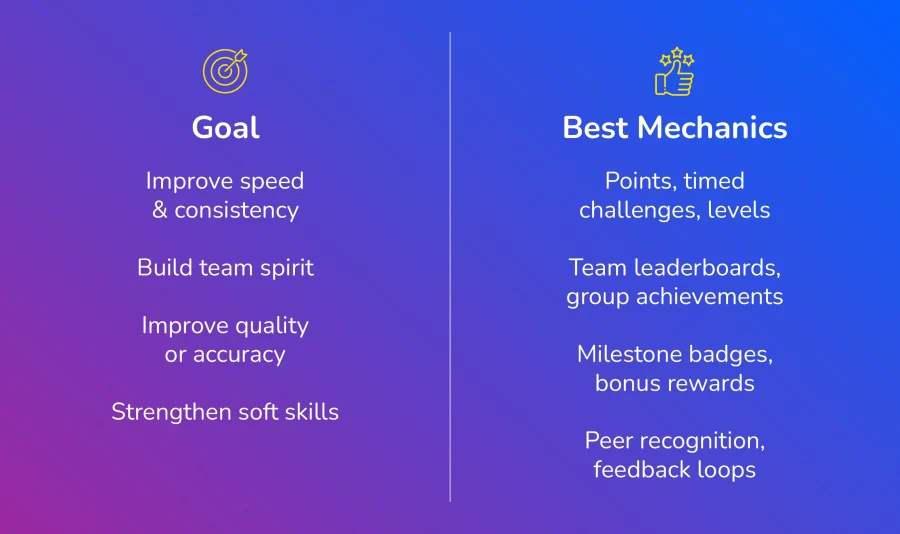
Now that the right mechanics are chosen, it’s time to put them into practice, and the first thing you need to know is: recognition shouldn’t be reserved for annual reviews or monthly meetings but put into display everyday.
Gamification helps make acknowledgment continuous and visible, so employees see the value of their contributions in real time. Some examples of these are:
Small moments of acknowledgment create a continuous culture of appreciation – something that deeply influences retention and morale.
Gamification works best when employees can see where they stand and what comes next. Transparent dashboards, progress bars, and goal scoreboards help people connect their tasks to bigger goals.
Employees should be able to answer at any moment “What am I working toward?”, “How am I doing?” and “What comes after this milestone?”. Transparency, clear progression and communication: key pillars to success.
Competition is powerful, but not always suitable for every team. A modern gamification strategy should encourage healthy challenges, not pressure or rivalry.
Gamification is most effective when it brings teammates together, not against each other.
So, how can teams actually implement all of this in a practical, scalable way? vaibe might be the answer.
With its gamification elements, vaibe becomes the bridge between strategy and execution. The core elements discussed throughout this article, such as recognition, challenges, feedback, and goal tracking, are exactly what vaibe is designed to support, bringing structure and consistency to engagement efforts without adding operational burden.
Kudos and shoutouts
Enable instant recognition by allowing managers and teammates to publicly acknowledge great work, reinforcing positive behaviors and making appreciation visible across the team.
Challenges and goal-based missions
Create structured challenges for individuals or teams that align daily activities with business objectives, helping employees stay focused, motivated, and accountable.
Dashboards with scores
Provide real-time visibility into progress and performance through intuitive dashboards, ensuring everyone understands where they stand and how their efforts contribute to shared goals.
Badges, levels and milestones
Automatically reward achievements and progress with visual markers that reinforce consistency, improvement, and long-term engagement without manual tracking.
Feedback loops
Collect continuous feedback from employees to identify what’s working and what needs adjustment, enabling managers to refine strategies and keep engagement high.
vaibe allows companies to amplify their culture, by making progress visible, recognition consistent, and collaboration effortless.
The result? A more connected, motivated workforce where gamification feels natural, human, and sustainable. Book a demo to see all this in action!
Share:


Understand how gamification boosts employee engagement by setting clear goals, rewarding accomplishments, and enhancing teamwork.
Discover how gamified performance review tools boost engagement, growth, and real-time feedback.
Struggling with disengaged teams, inefficiencies or high turnover?
Discover how gamification transforms challenges into wins!
Isabelle Krause, Head of HR & Culture at Körber Digital, wrote this article to explore the impact of gamification in the field. She highlights where gamification adds value and where its limitations call for a well-defined strategy.