


Employee turnover in warehouse settings is an issue companies currently face. Repetitive work and lack of recognition are some of the main causes for it. But how can this issue be tackled? Gamification might be the answer.

Back to Blog
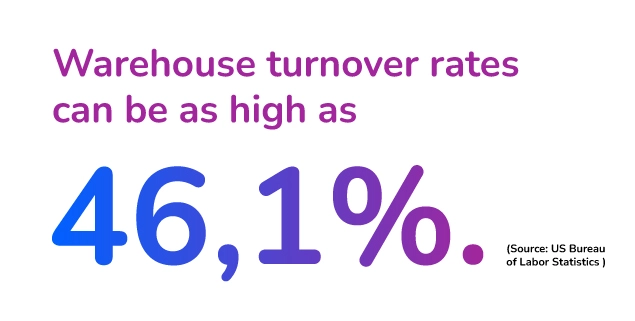
Warehouses have become one of the pillars of modern commerce, from fulfilling e-commerce demand to enabling global supply chains. Yet despite their importance, warehouse operations consistently struggle with one of the highest turnover rates across industries. According to the US Bureau of Labor Statistics, warehouse turnover rates can reach a staggering 46,1%.
But why is that?
Repetitive tasks, demanding physical workloads, and limited recognition can be appointed as some of the reasons for this high numbers. As team members feel disengaged and underappreciated, the tendency to leave their jobs increases greatly. This creates major costs for businesses, both in recruiting new workers and maintaining high performance levels without breaks.
Addressing turnover requires more than temporary fixes. Long-term workforce retention relies on a work environment that makes employees feel seen, supported, and motivated. This is where gamification offers a promising new approach.
This article explores practical ways warehouses can use gamification to improve retention, strengthen workforce engagement, and create a more supportive, motivating work culture. Let’s dive in.
Warehouses face turnover because the typical work experience can feel… empty and mechanical. Repetitive picking, lifting, scanning, and shipping, even if extremely necessary, can become demotivating without meaningful feedback, goals, or recognition. This often leads to some challenges that warehouses face, such as:
All these challenges can result in business consequences, such as increased hiring and training costs, lower operational efficiency, and less team cohesion.
Warehouse turnover relates directly to how businesses succeed. So, how can companies address it?
Gamification makes work experiences engaging, transparent, and progress-oriented, transforming routine tasks into opportunities for achievement and growth. For warehouses, it’s less about games for games’ sake, and more about designing work in ways that tap into basic human motivators:
When these elements are built into daily routines, employees feel more connected to their work and their coworkers, staying longer in their jobs. So, the question is: how can they be implemented in the real world? That’s what we’ll find out.
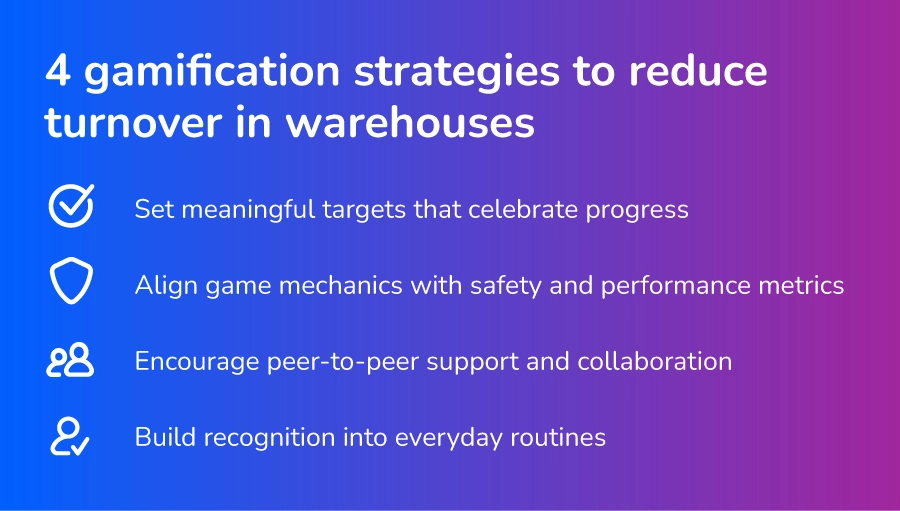
Rather than only tracking output as raw numbers, gamification encourages warehouses to define meaningful targets that help workers feel a sense of accomplishment.
How to apply?
Visualization matters: dashboards that show individual progress toward goals provide clarity and a sense of forward movement.
Why this reduces turnover: When employees observe steady progress, they feel growth and achievement, making them more likely to stay.
In warehouse environments, safety is as important as productivity. Gamification can reward not just speed, but smart, safe behaviors that reduce accidents and absenteeism (which also contribute to turnover).
How to apply?
Why this reduces turnover: This approach reinforces that excellence includes doing work well and safely, creating a culture where people feel protected and valued.
High turnover often stems from a sense of isolation or lack of community. Gamification can strengthen social bonds by incorporating recognition among peers.
How to apply?
Why this reduces turnover: When employees feel supported, they are more engaged, less likely to leave, and more willing to contribute to long-term team success.
Recognition is a powerful retention tool. Traditional performance reviews come too infrequently and lack immediacy. But gamification makes recognition a regular experience.
How to apply?
Why this reduces turnover: Employees who feel valued are significantly more likely to stay with a company, refer others, and contribute to performance improvements.
vaibe’s Gamification as a Service solution includes all the tools mentioned in the strategies above, from badges to scoreboard, kudos, and much more. It allows warehouse leaders to build gamified experiences that are customizable, collaborative, and motivational.
With vaibe, warehouses can not only improve productivity but also nurture a workforce that feels invested in the work they do. This reduces turnover and strengthens long-term performance.
Warehouse turnover is a costly challenge rooted in disengagement, limited feedback, and a lack of opportunities for meaningful progress. But gamification in a warehouse setting offers a practical, human-centered way to tackle these issues.
With vaibe, warehouse operations can transition from repetitive and transactional to dynamic and rewarding, creating an environment where employees truly want to stay and succeed. Curious? See it for yourself with a guided demo from our team!
Share:


Understand how gamification boosts employee engagement by setting clear goals, rewarding accomplishments, and enhancing teamwork.
Find out how vaibe engagement layer boosts operational efficiency in warehouses with gamification.
In this exclusive interview, we explore the challenges and opportunities of gamification in retail, how vaibe is transforming both customer and employee engagement and what the future holds for driving motivation and productivity through smart game mechanics.
Learn how a gamified solution can engage employees, reduce turnover, and enhance last mile delivery productivity.